Projects
Publications
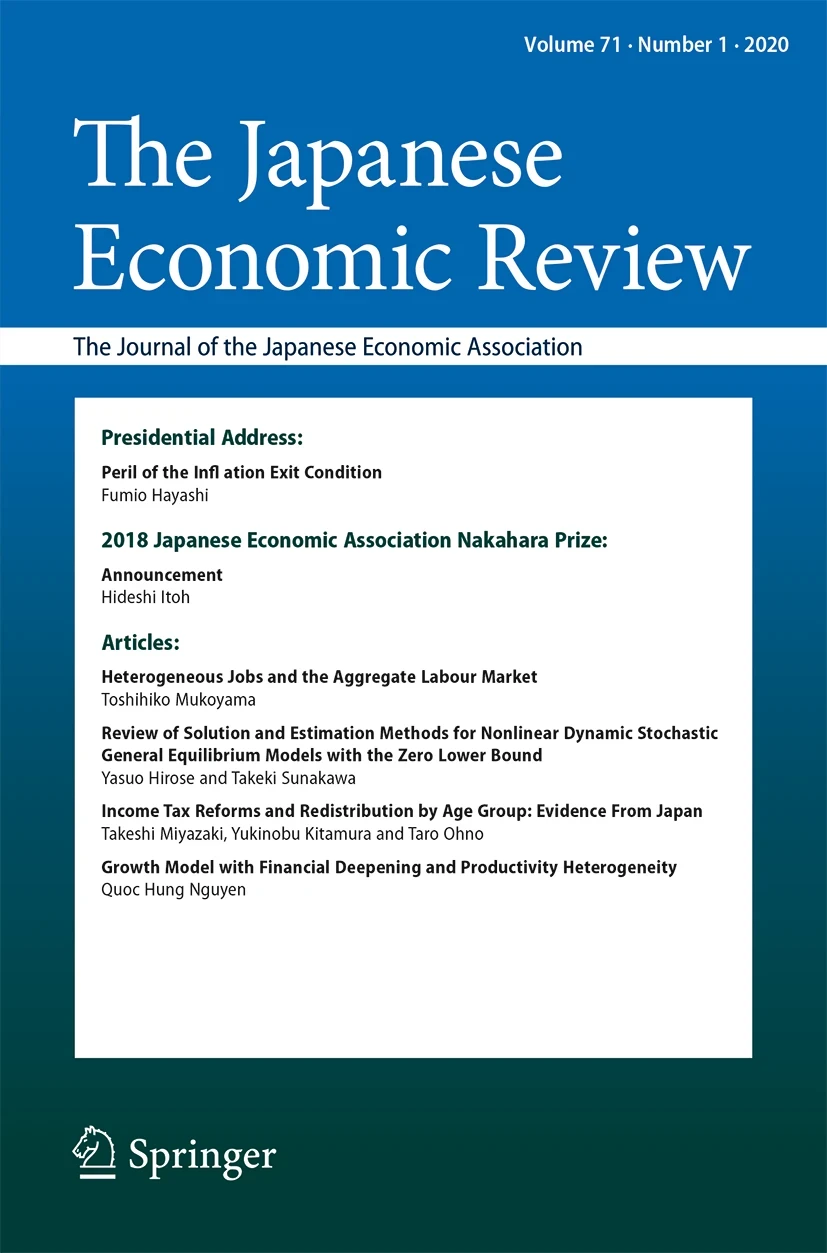
Treatment Choice, Mean Square Regret and Partial Identification
The Japanese Economic Review
We consider a decision maker who faces a binary treatment choice when their welfare is only partially identified from data. We contribute to the literature by anchoring our finite-sample analysis on mean square regret, a decision criterion advocated by Kitagawa, Lee, and Qiu (2022). We find that optimal rules are always fractional, irrespective of the width of the identified set and precision of its estimate. The optimal treatment fraction is a simple logistic transformation of the commonly used t-statistic multiplied by a factor calculated by a simple constrained optimization. This treatment fraction gets closer to 0.5 as the width of the identified set becomes wider, implying the decision maker becomes more cautious against the adversarial Nature.
Statistical Decisions and Partial Identification: With Application to Boundary Discontinuity Design
Chen Qiu, Jörg Stoye
Forthcoming in R. Griffith, Y. Gorodnichenko, M. Kandori, and F. Molinari (eds.), Advances in Economics and Econometrics: Thirteenth World Congress, Cambridge University Press.
We are delighted to respond to the excellent surveys by Cattaneo et al. (2026) and Hirano (2026). Our discussion will attempt two things: first, we show how statistical decision theory can be applied to situations with partial identification; second, we connect the surveys' themes by applying these insights to an imagined policy experiment in one of Cattaneo et al.'s (2025) applications.
To do so, we lay out a stylized scenario of statistical decision making under partial identification and, drawing on our own and others' earlier work, provide a complete solution for that scenario. We then apply these results to a hypothetical reduction (modelled on actual policies) in eligibility for educational subsidies. We will see that something of interest can be said, but also that bringing the theory to the application involves some leaps of faith and leaves some questions open. This leads to the final section, where we discuss what we see as the main open challenges in statistical decision theory under partial identification.
Decision Theory for Treatment Choice Problems with Partial Identification
José Luis Montiel Olea, Chen Qiu, Jörg Stoye
Forthcoming in The Review of Economic Studies.
We apply classical statistical decision theory to a large class of treatment choice problems with partial identification. We show that, in a general class of problems with Gaussian likelihood, all decision rules are admissible; it is maximin-welfare optimal to ignore all data; and, for severe enough partial identification, there are infinitely many minimax-regret optimal decision rules, all of which sometimes randomize the policy recommendation. We uniquely characterize the minimax-regret optimal rule that least frequently randomizes, and show that, in some cases, it can outperform other minimax-regret optimal rules in terms of what we term profiled regret. We analyze the implications of our results in the aggregation of experimental estimates for policy adoption, extrapolation of Local Average Treatment Effects, and policy making in the presence of omitted variable bias.
Robust Bayes Treatment Choice with Partial Identification
Forthcoming in Econometric Theory.
We study a class of binary treatment choice problems with partial identification through the lens of robust (multiple prior) Bayesian analysis. We use a convenient set of prior distributions to derive ex-ante and ex-post robust Bayes decision rules, both for decision makers who can randomize and for decision makers who cannot.
Our main messages are as follows: First, ex-ante and ex-post robust Bayes decision rules do not agree in general, whether or not randomized rules are allowed. Second, randomized treatment assignment for some data realizations can be optimal in both ex-ante and, perhaps more surprisingly, ex-post problems. Therefore, it is usually with loss of generality to exclude randomized rules from consideration, even when regret is evaluated ex post. We apply our results to a stylized problem where a policy maker uses experimental data to choose whether to implement a new policy in a population of interest, but is concerned about the external validity of the experiment at hand (Stoye, 2012); and to the aggregation of data generated by multiple randomized control trials in different sites to make a policy choice in a population for which no experimental data are available (Manski, 2020; Ishihara and Kitagawa, 2021).
Treatment Choice with Nonlinear Regret
Forthcoming in Biometrika.
The literature focuses on the mean of welfare regret, which can lead to undesirable treatment choice due to sensitivity to sampling uncertainty. We propose to minimize the mean of a nonlinear transformation of regret and show that singleton rules are not essentially complete for nonlinear regret. Focusing on mean square regret, we derive closed-form fractions for finite-sample Bayes and minimax optimal rules. Our approach is grounded in decision theory and extends to limit experiments. The treatment fractions can be viewed as the strength of evidence favoring treatment. We apply our framework to a normal regression model and sample size calculation.
Working Papers
Epsilon-Minimax Solutions of Statistical Decision Problems
A decision rule is epsilon-minimax if it is minimax up to an additive factor epsilon. We present an algorithm for provably obtaining epsilon-minimax solutions for a class of statistical decision problems. In particular, we are interested in problems where the statistician chooses randomly among I decision rules. The minimax solution of these problems admits a convex programming representation over the (I-1)-simplex. Our suggested algorithm is a well-known mirror subgradient descent routine, designed to approximately solve the convex optimization problem that defines the minimax decision rule. This iterative routine is known in the computer science literature as the hedge algorithm and is used in algorithmic game theory as a practical tool to find approximate solutions of two-person zero-sum games. We apply the suggested algorithm to different minimax problems in the econometrics literature. An empirical application to the problem of optimally selecting sites to maximize the external validity of an experimental policy evaluation illustrates the usefulness of the suggested procedure.
Approximate Least-Favorable Distributions and Nearly Optimal Tests via Stochastic Mirror Descent
We consider a class of hypothesis testing problems where the null hypothesis postulates distributions for the observed data, and there is only one possible distribution under the alternative. We show that one can use a stochastic mirror descent routine for convex optimization to provably obtain - after finitely many iterations - both an approximate least-favorable distribution and a nearly optimal test, in a sense we make precise. Our theoretical results yield concrete recommendations about the algorithm's implementation, including its initial condition, its step size, and the number of iterations. Importantly, our suggested algorithm can be viewed as a slight variation of the algorithm suggested by Elliott, Müller, and Watson (2015), whose theoretical performance guarantees are unknown.
Externally Valid Selection of Experimental Sites via the k-Median Problem
We present a decision-theoretic justification for viewing the question of how to best choose where to experiment in order to optimize external validity as a -median problem, a popular problem in computer science and operations research. We present conditions under which minimizing the worst-case, welfare-based regret among all nonrandom schemes that select sites to experiment is approximately equal - and sometimes exactly equal - to finding the k most central vectors of baseline site-level covariates. The k-median problem can be formulated as a linear integer program. Two empirical applications illustrate the theoretical and computational benefits of the suggested procedure
Evaluating Counterfactual Policies Using Instruments
We study settings in which a researcher has an instrumental variable (IV) and seeks to evaluate the effects of a counterfactual policy that alters treatment assignment, such as a directive encouraging randomly assigned judges to release more defendants. We develop a general and computationally tractable framework for computing sharp bounds on the effects of such policies. Our approach does not require the often tenuous IV monotonicity assumption. Moreover, for an important class of policy exercises, we show that IV monotonicity -- while crucial for a causal interpretation of two-stage least squares -- does not tighten the bounds on the counterfactual policy impact. We analyze the identifying power of alternative restrictions, including the policy invariance assumption used in the marginal treatment effect literature, and develop a relaxation of this assumption. We illustrate our framework using applications to quasi-random assignment of bail judges in New York City and prosecutors in Massachusetts.
Leave No One Undermined: Policy Targeting with Regret Aversion
While the importance of personalized policymaking is widely recognized, fully personalized implementation remains rare in practice, often due to legal, fairness or cost concerns. We study the problem of policy targeting for a regret-averse planner when training data gives a rich set of observables while the assignment rules can only depend on its subset. Our regret-averse criterion reflects a planner's concern about regret inequality across the population. This, in general, leads to a fractional optimal rule due to treatment effect heterogeneity beyond the average treatment effects conditional on the subset of observables. We propose a debiased empirical risk minimization approach to learn the optimal rule from data and establish favorable, new upper and lower bounds for the excess risk, indicating a convergence rate of 1/n and asymptotic efficiency in certain cases. We apply our approach to the National JTPA Study and the International Stroke Trial.